How Tip Pooling Works
Last reviewed
Tip pools vs tip-outs
The two get mixed up all the time, but they work differently:
| Question | Tip pool | Tip-out |
|---|---|---|
| Who pays in | The roles set up to contribute | One employee at a time |
| How it’s split | One rule for the whole group | A set share from each person |
| Typical roles | Servers, bartenders, bussers, hosts | Servers tipping out bussers, the bar, or the kitchen |
Common ways to split a pool
Most pools use one of three rules. Each one is fair in a different way, so pick the one that matches how your team actually works.
By hours
Everyone gets a share based on how long they worked. With $600 in the pool and 40 total hours, a busser who worked 10 hours gets $150.
By job title
Each role gets a set percentage of the pool. For example, bartenders 50%, bussers 30%, and hosts 20%, split among whoever worked each role.
By points
Each role is worth points, say a server 10 and a busser 5. Divide the pool by the total points to get what one point is worth.
Any of these can also run check by check instead of once a day. Each check’s tip then goes only to the people who were clocked in when it was paid, which feels fairer on days when the lunch crew and the dinner crew are different people.
What federal law says
Tips belong to the employees who earned them. Since 2018, federal law says an employer can’t keep employees’ tips, and neither can managers or supervisors, even by taking a share of a pool (FLSA, 29 U.S.C. 203(m)(2)(B)).
Who else can be in the pool depends on how you pay:
- If you take a tip credit (paying less than minimum wage and counting tips toward it), the pool can include only employees who customarily receive tips, like servers, bartenders, and bussers.
- If you pay full minimum wage and take no tip credit, the pool can also include back-of-house employees such as cooks and dishwashers (29 CFR 531.54).
What changes in California
California is stricter in a few ways that matter for restaurants:
- No tip credit. Every employee earns at least minimum wage before tips (Labor Code section 351).
- Tips belong to employees. The owner, managers, and other agents of the employer can’t share in them.
- Mandatory pools are allowed. An employer may require servers to share tips with the other employees who help serve the guest (Leighton). That includes back-of-house staff in the chain of service, like cooks and dishwashers (Etheridge).
- Card tips are paid in full. Tips left on a credit card go to the employee without any processing fee taken out, no later than the next regular payday (Labor Code section 351).
What this looks like in practice
Here’s a real pool setup: bartenders give 20% of each check, bussers get half of the pool, and cooks and hosts share the other half as a group.
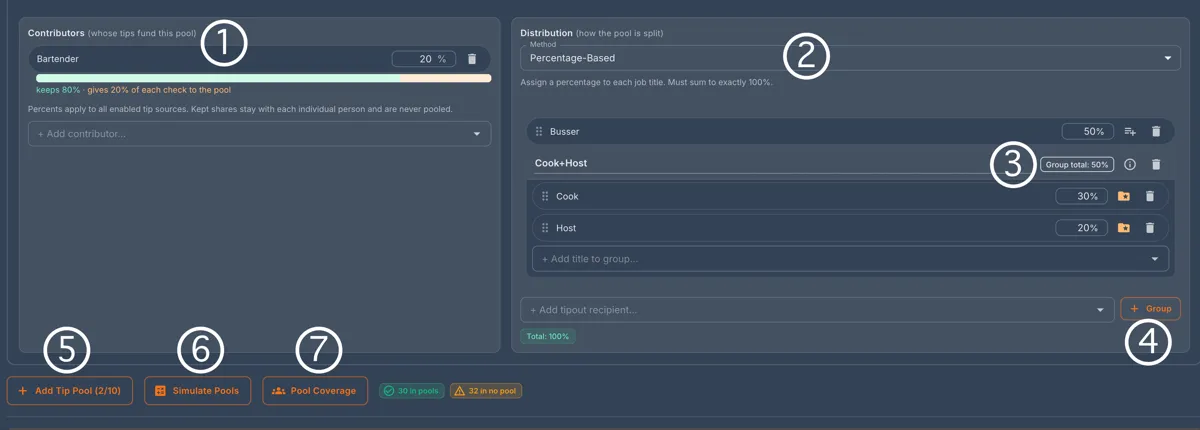
- Who pays into the pool
- How the pool is split
- A group of roles sharing one slice
- Adding a group
- Adding another pool
- Testing the setup on past weeks
- Seeing who is and isn't in a pool
Setting up a fair pool
A pool works best when nobody has to guess how it works. A few habits go a long way:
- Write the policy down and share it with everyone who pays in or gets paid out.
- Apply the same rule every shift. Exceptions are where disputes start.
- Keep a record of every split, so you can answer “why did I get this much?” with numbers.
- Review the pool when roles change, like adding a barback or a new host position.
This guide is general information, not legal advice. Laws change and every business is different, so talk with an employment attorney about your situation.
Sources
- Fair Labor Standards Act, 29 U.S.C. 203(m)(2)(B)
- 29 CFR 531.54 (tip pooling)
- U.S. Department of Labor Fact Sheet #15: Tipped Employees Under the FLSA
- California Labor Code section 351
- Leighton v. Old Heidelberg, Ltd. (1990) 219 Cal.App.3d 1062
- Etheridge v. Reins International California, Inc. (2009) 172 Cal.App.4th 908
- IRS Revenue Ruling 2012-18 (tips vs service charges)
- O'Grady v. Merchant Exchange Productions, Inc. (2019) 41 Cal.App.5th 771